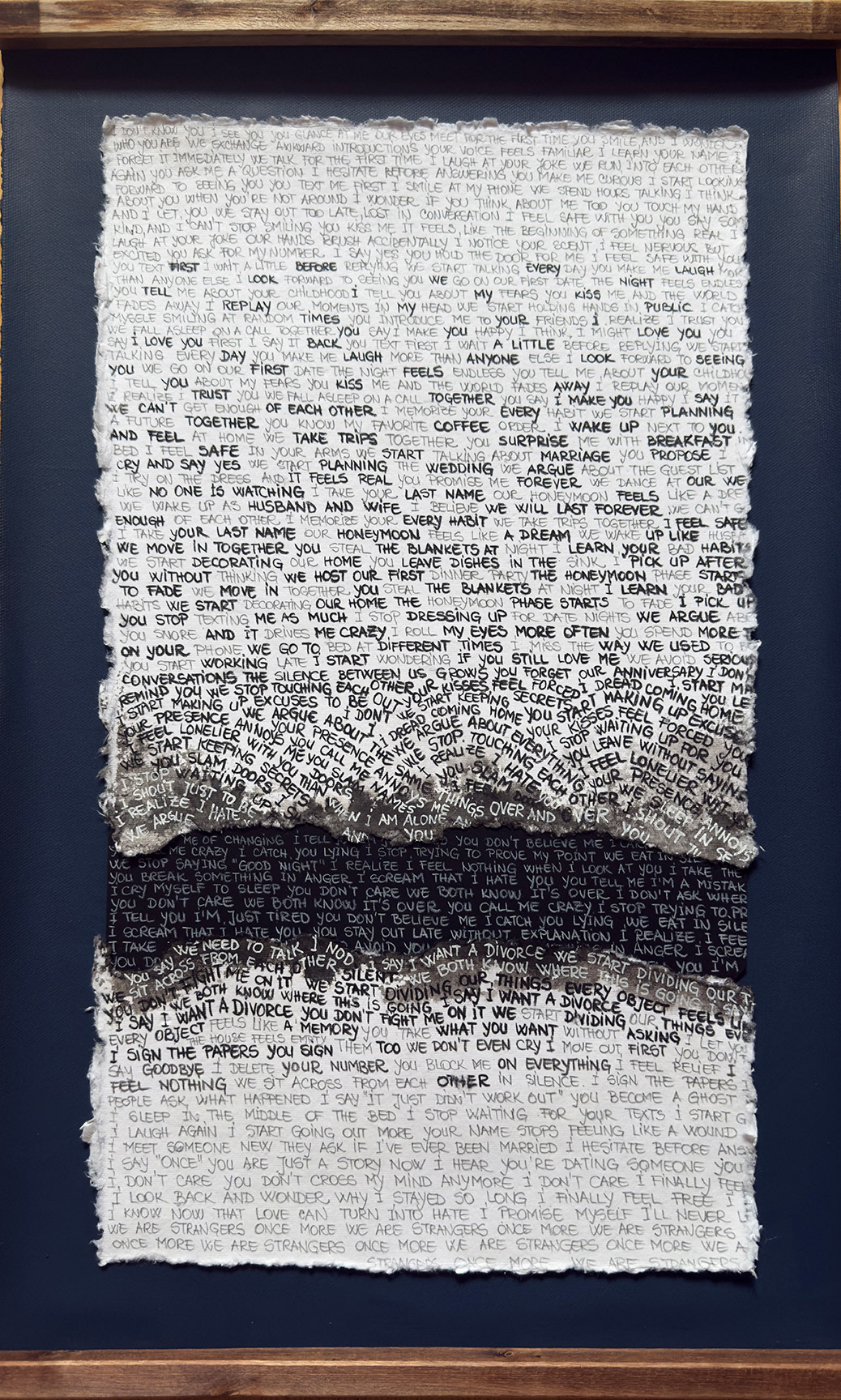
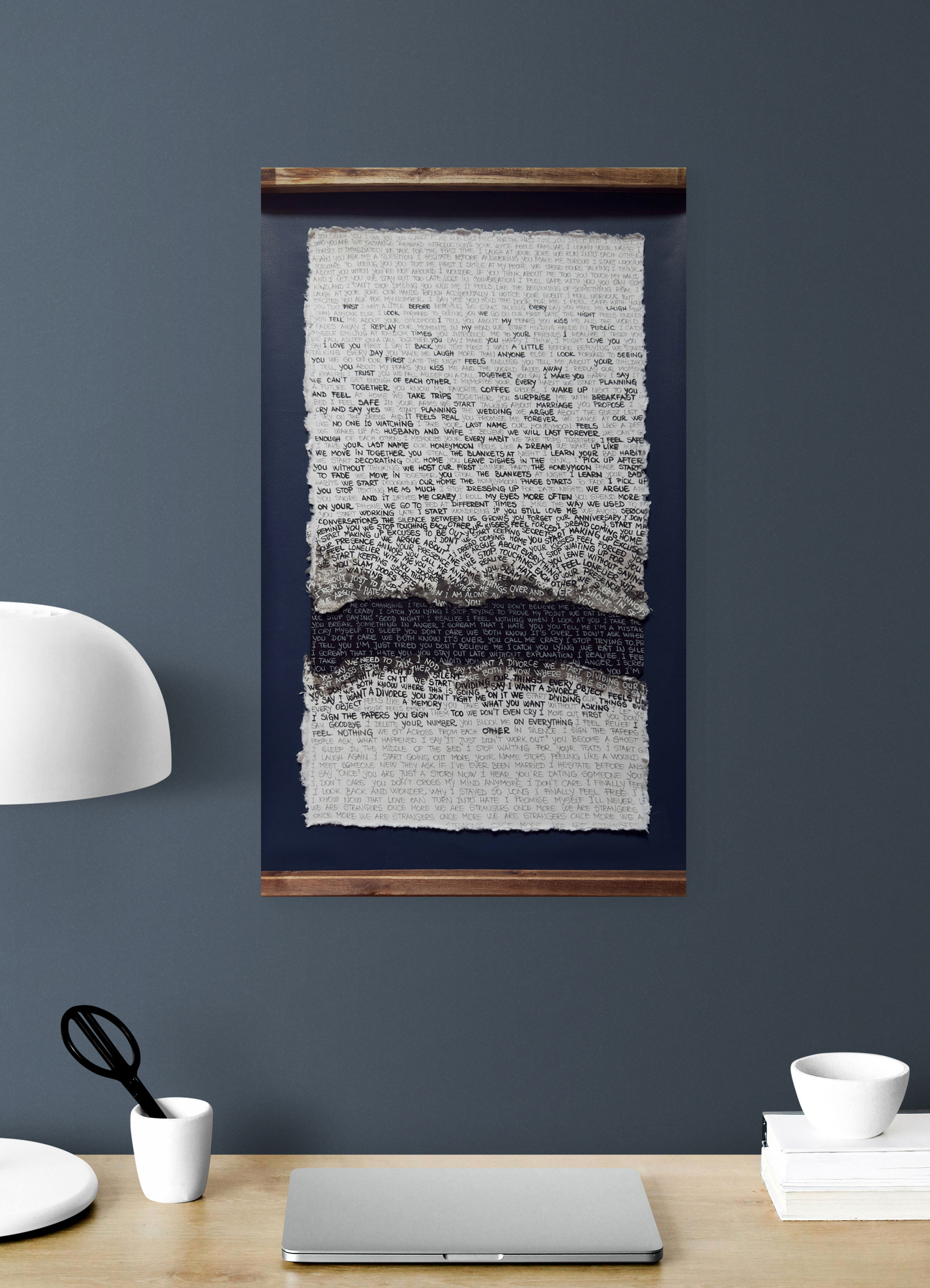
This work compresses the full duration of a relationship into a single, continuous surface where language does not recount experience—it reenacts it. The text unfolds as a sequence of states: recognition, attachment, repetition, strain, fracture, and eventual detachment. These are not presented as isolated moments, but as overlapping conditions that coexist, eroding the idea of linear time.
Eight Echoes of Us positions the relationship as a system of recurrence. What appears to move forward is, in fact, a series of returns—phrases, gestures, and patterns re-emerging under altered pressure. Each “echo” marks a phase, but also a distortion: language gradually loses its ability to connect and begins to repeat without resolution. Meaning is not lost instantly; it degrades through accumulation.
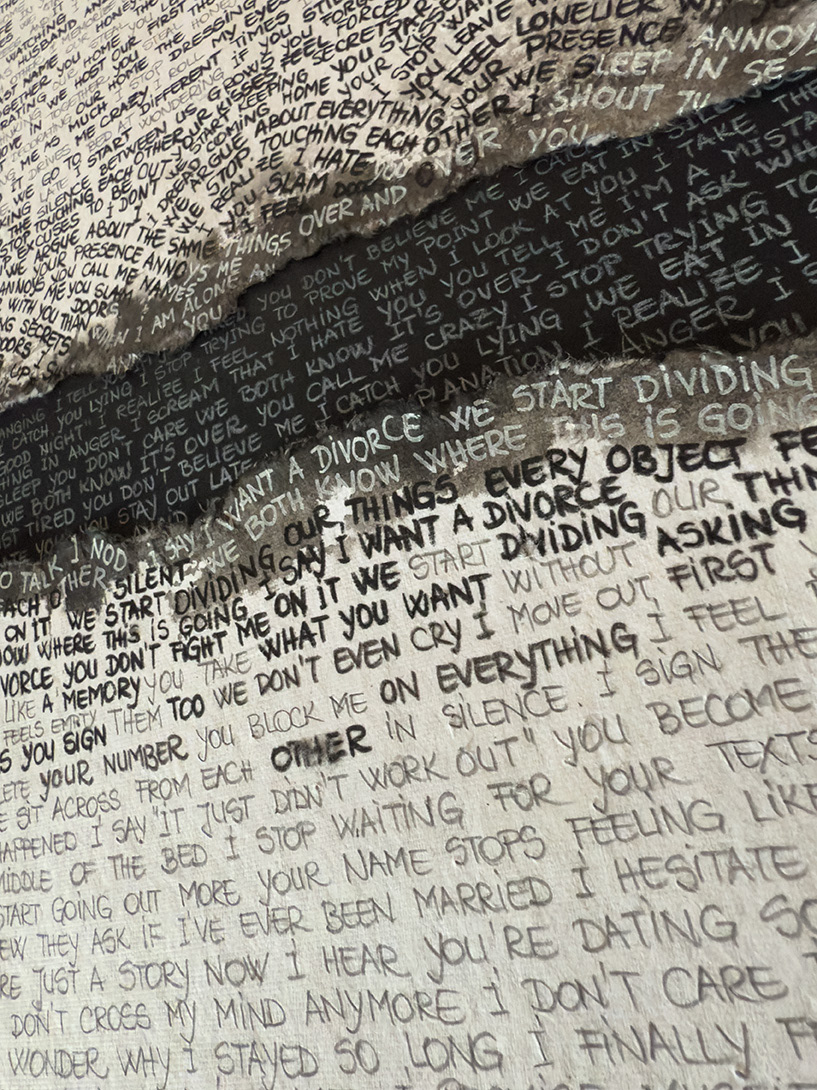
This process is embedded in the material. The upper field remains ordered and legible, where language still functions as exchange. As the surface descends, the writing compresses, overlaps, and darkens. Communication becomes density. The act of writing persists, but its capacity to reach the other collapses. The surface records not only what is said, but the growing failure of language as a shared space.
A physical rupture interrupts this continuity. The tear divides the work into two incompatible conditions: above it, language still carries the assumption of continuity; below it, language becomes residue. Statements shorten, harden, and repeat. Declarations such as “I want a divorce” no longer operate as singular turning points—they appear as one more iteration within an exhausted cycle.
The work does not resolve. It thins out. The final lines return to distance, to neutrality, to the condition of strangers—not as a conclusion, but as a state that feels structurally inevitable.
The “eight echoes” do not end with separation. They persist as residual patterns—forms of language that continue to repeat even after the relationship itself has collapsed. What remains is not narrative, but trace: a system that continues to exist beyond the people who produced it.